

Our impact
BPET is an educational charity which supports 12 primary schools across London and Berkshire. We are very proud of the academic rigour our schools follow, and the great outcome our pupils achieve through a rich and broad curriculum offer, taught with exciting approaches with reasoning and critical thinking at its heart.
Top schools in England 2025
The Times has published the top 1,000 highest performing state primary schools in England, with Deer Park School (39th, up from 161 last year), Rutherford House School (117), Whiteknights Primary School (609) and Braywick Court School (824) all recognised among the country’s highest‑performing schools in 2025.
Deer Park School was also ranked 14th in the School Guide’s Top 100 Primary Schools in England (2025). The list represents the highest-performing schools nationally, based on pupils’ attainment in the 2024 SATs across reading, writing, and maths.
Rutherford House School ranked in the Top 50 schools in England according to The Telegraph’s national rankings published in September 2025. The rankings use a scoring system based on the percentage of pupils achieving and exceeding the expected standard in reading, writing, and mathematics at Key Stage 2.
Top 11% of primary academy trusts in England
BPET is in the top 11% of all primary academy trusts as a combined average, being ranked 71 out of 626 academy trusts with three or more primary schools. Only 14 trusts ranked higher than BPET have the same number or more schools than BPET.
View BPET's first ever published performance measures on the Department for Education website (refers to eight schools only).
Pupil Attainment Outcomes: SATs 2025
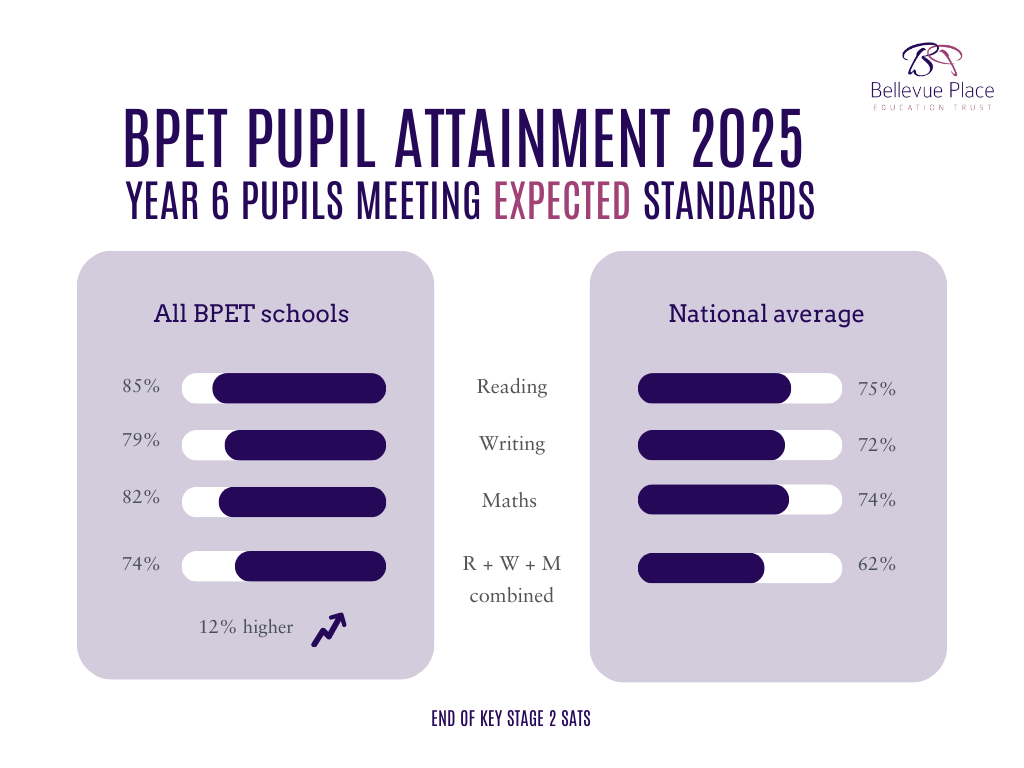
- 74% of Year 6 pupils met the expected standard in reading, writing and maths combined in 2025 - 12% above the national average
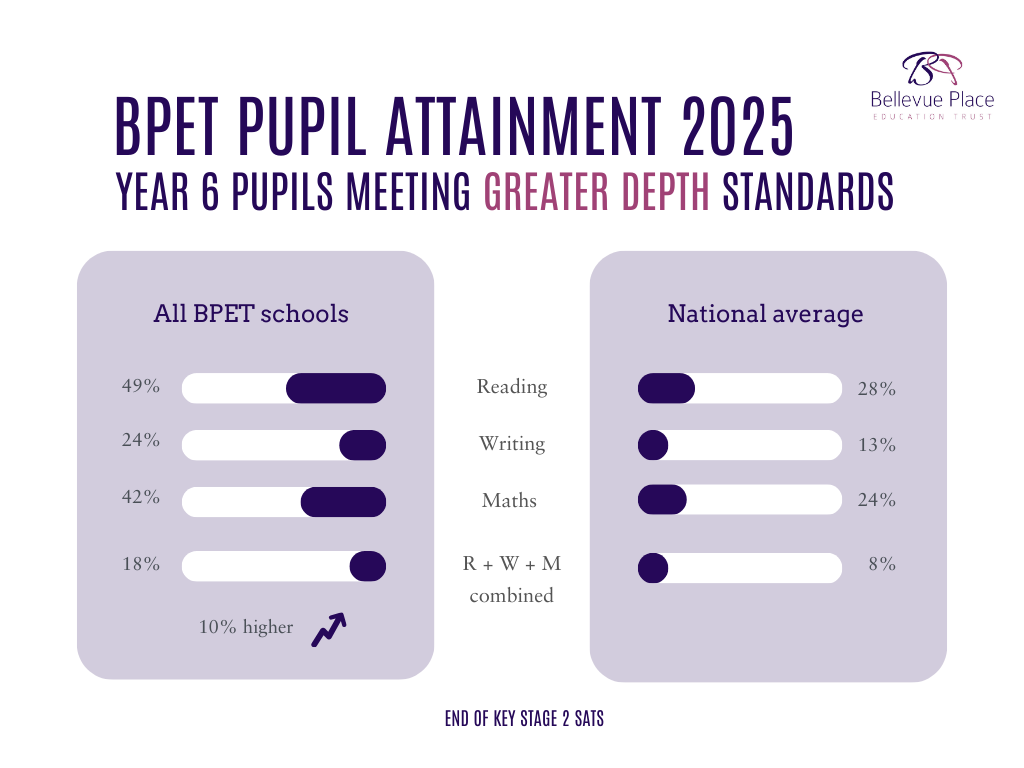
- 18% of Year 6 pupils achieved greater depth stand in reading, writing and maths combined in 2025 - 10% above the national average
- 64% of Year 6 Pupil Premium pupils met the expected standard in reading, writing and maths combined in 2025 - 18% above the national average
- 47% of Year 6 pupils identified with Special Education Needs met the expected standard in reading, writing and maths in 2025 - 25% above the national average.
Early Years achievements
- In 2025, at the end of Year 1, 88% of pupils were at or above expected phonics check standard – 12% above the national average of 76%.
- In 2025, at the end of Reception, 76% of pupils were at a good level of development, which is 9% above the national average of 67%.
Ofsted Outcomes
All BPET schools have been judged by Ofsted to be Good with four schools (33%) judged as Outstanding:
- Five are Good schools (Watling Park School, Halley House School, Whitehall Park School, Rivermead Primary School and Dollis Primary School)
- Three are Good with outstanding features (Rutherford House School, Whiteknights Primary School and Kilburn Grange School); and
- Four are judged as Outstanding (Braywick Court School, Deer Park School, Evendons Primary School and The Heights Primary School).
Parental survey results in 2025
Parental support for our schools has been and continues to be very strong. Here are our findings following our annual parents survey across all BPET schools:
-
93% of parents and carers strongly agree or agree that their child enjoys coming to school
-
90% of parents and carers strongly agree or agree that their school’s values and attitudes have a positive effect on their child
- 88% ranked their response as highly likely or likely to recommend their school to friends
Survey results are important to us and feed into our planning for future academic years, ensuring that our educational offer meets the needs of the communities we serve.
Top schools in England 2024
Last year, Deer Park School (161), Whiteknights Primary School (193) and Rutherford House School (214) have been mentioned in The Sunday Times top 500 primary schools list (2024). The list is made up by almost 3% of the 16,783 primaries in England, and takes into account pupils' attainment in the 2023 SATs (combined reading, writing and maths), as well as how well schools have helped the so-called “lost generation” to recover after Covid.